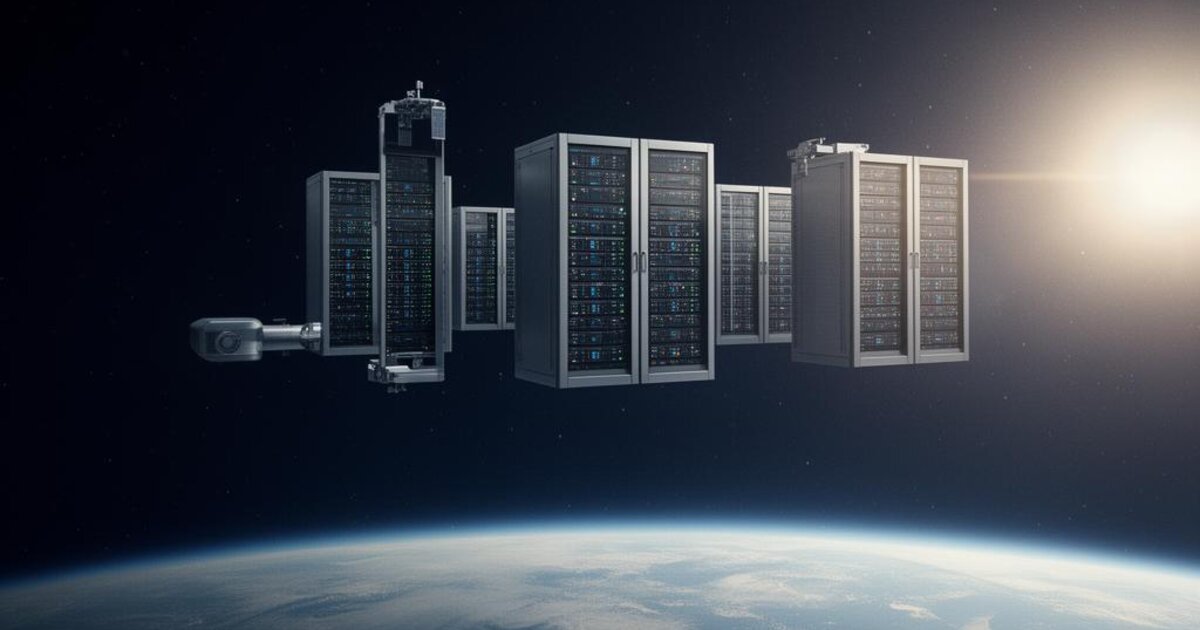
Musk Wants to Move AI Data Centers to Space. Here's What's Actually True.
Elon Musk says the future of AI compute is in orbit, powered by sunlight. Here's what he's actually proposed, what xAI and SpaceX have built, and where independent experts say the plan still breaks down.
Elon Musk has spent the past several months pitching one of his most audacious ideas yet: that the future of artificial intelligence belongs not in warehouses across Virginia and Texas, but in orbit. Powered by the sun, running above the clouds, and beaming results back to Earth. The claim has circulated widely, often in garbled form. So it's worth separating what Musk has actually said and done from what remains speculation.
What Musk has said
Musk's core argument is that AI data centers should move off the planet and run on space-based solar power. His reasoning rests on a simple physical advantage: in the right orbit, a solar panel receives near-constant sunlight, with no night, no weather, and no atmosphere dimming the light. Musk has claimed solar collected in space is roughly five times more effective than the same panels on the ground.[1] In November 2025, he went further, arguing that space becomes the lowest-cost option once you need to power and cool data centers at the scale of hundreds of gigawatts, because continuous sunlight removes the need for batteries.[1]
He has also put timelines on it. Speaking at the World Economic Forum in Davos in January 2026, Musk said full-scale deployment could be possible within two to three years.[2] In a podcast preview around the same period, he was more specific, predicting that in roughly 30 to 36 months “the most economically compelling place to put AI will be space.”[3] His shorthand for the whole concept, posted on SpaceX's website: “It's always sunny in space!”[4]
What he has actually done
This is no longer just talk. In early February 2026, Musk merged SpaceX with his AI startup xAI into a single private company valued at an estimated $1.25 trillion, with building solar-powered “orbital data centers” stated as a central goal.[5] SpaceX has also filed a request with the U.S. Federal Communications Commission for an orbital data center constellation that could eventually include up to one million satellites in low Earth orbit, linked by lasers and powered mainly by solar.[6] Musk has tied the effort to a possible SpaceX initial public offering as early as 2026.[5]
The plan leans heavily on SpaceX's Starship rocket. Because the economics depend on cheap launches, Musk has framed reusability as the key: throwing away a rocket after each flight is ruinously expensive, while reusing it reduces the cost toward little more than fuel. Industry analysts watching the sector say the metric to watch is Starship's all-in cost per kilogram to orbit; some cite a threshold near $500 per kilogram as the point where commercial scaling becomes plausible.[6]
Why anyone is considering this
The motivation traces directly back to a problem unfolding on the ground. AI's appetite for electricity is straining power grids and driving up costs. U.S. data centers consumed roughly 4% of the nation's electricity in 2024, a share the Pew Research Center says is expected to more than double by 2030.[7] A U.S. Department of Energy report from Lawrence Berkeley National Laboratory projects data centers could reach as much as 12% of national electricity use by 2028.[8] Communities have begun pushing back over power demand, water use for cooling, and land.[17] Moving compute into orbit is, in part, an attempt to sidestep those terrestrial limits. As Musk framed it, the goal is to expand AI without triggering blackouts or sending utility bills soaring.
Musk is not the only one
Far from being a lone Musk fixation, orbital computing has become a crowded race. Google announced Project Suncatcher in November 2025, a plan to put its custom Tensor Processing Unit chips on solar-powered satellites; the company makes a similar pitch, noting that a panel in the right orbit can be up to eight times more productive than on Earth. Google plans two prototype satellites by early 2027 in partnership with Planet Labs.[9]
Startups are moving faster on demonstrations. Starcloud, backed by Nvidia, launched a small demonstrator carrying an Nvidia processor in November 2025 and has filed plans for a large constellation of its own.[10] Axiom Space launched its first orbital data center nodes in January 2026.[11] Meanwhile Jeff Bezos has predicted gigawatt-scale data centers in space within roughly a decade or two,[12] and former Google CEO Eric Schmidt has said he acquired a rocket company partly to pursue orbital data centers.[13] Nvidia, the dominant supplier of AI chips, announced its own space-computing initiative in March 2026.[14]
The skepticism is substantial
Scientists and industry experts say Musk faces formidable technical, financial, and environmental obstacles, and many doubt his timeline.
The economics are the first hurdle. Even if Starship dramatically lowers launch costs, analysts note that boosting massive computing hardware into orbit, then powering and cooling it there, remains expensive and unproven at scale. Cooling is a particular challenge: on Earth, data centers shed heat into air or water, but space is a vacuum, requiring large radiators to dump heat by radiation alone.
Hardware reliability is another. The specialized chips that AI relies on degrade and fail. On Earth, a technician swaps a broken part; in orbit, repair is impractical, and radiation accelerates wear. Building the necessary structures would mean, in Musk's own description, massive and fragile assemblies that have never been constructed before.
Then there is space debris. A single malfunctioning satellite could trigger a cascade of collisions. Critics note that Musk wants to operate roughly a million satellites,[6] a hundredfold jump from the roughly 10,000 Starlink craft already in orbit.[15] A former NASA engineer warned that such density could reach a tipping point where collision risk becomes unmanageable, with objects traveling around 17,500 miles per hour capable of violent impacts that disrupt weather forecasting, communications, and other services.[16]
Where things actually stand
The honest summary is this. As of mid-2026, no AI data center is operating in space, and energy production for data centers has not moved off Earth. What exists is a stated ambition, a regulatory filing, a corporate merger built around the idea, and a handful of small in-orbit demonstrations by various companies testing whether chips can even survive and function in that environment. The field is in an early demonstration phase, with prototypes and test satellites, not commercial operations.
Musk has a record of pursuing long-odds bets that critics dismissed, from electric cars to reusable rockets, and then delivering. He is also known for aggressive timelines that slip. Both things can be true. The accurate way to describe the situation is that Musk has proposed, and begun laying groundwork for, solar-powered AI data centers in space, and has publicly targeted a two-to-three-year horizon, while many experts remain unconvinced it will happen that soon, if at all.
So the claim that energy production for data centers “will move to outer space soon” overstates a real but unproven plan. It is a serious, well-funded ambition shared by several major players. It is not, yet, a reality.
Sources
- C-SPAN: Musk & Nvidia CEO at U.S.–Saudi Investment Forum (Nov 2025)
- pv magazine: Musk at WEF — solar space-based AI data centers possible in 2–3 years
- Dwarkesh Podcast: Elon Musk interview (Feb 2026)
- SpaceX: Orbital Data Centers update
- TechCrunch: SpaceX acquires xAI in data-centers-in-space merger
- SpaceNews: SpaceX files plans for million-satellite orbital data center constellation
- Pew Research Center: Energy use at U.S. data centers amid the AI boom
- U.S. Department of Energy: Report on electricity demand from data centers
- Google Blog: Project Suncatcher
- Data Center Dynamics: Starcloud-1 reaches orbit with Nvidia H100 GPU
- SpaceNews: Axiom Space to launch orbital data centers on Kepler satellites
- Data Center Dynamics: Bezos predicts gigawatt data centers in space
- Ars Technica: Eric Schmidt bought Relativity Space to put data centers in orbit
- NVIDIA Newsroom: NVIDIA launches space computing initiative
- Ars Technica: SpaceX launches 10,000th Starlink satellite
- NASA Orbital Debris Program Office: FAQ
- Associated Press: Communities push back on data centers over power, water, and land use
Comments
Loading comments…